Recently updated trade statistics reveal that U.S. Customs and Border Protection (“CBP”) collected over $225.8 billion in duties, taxes, and fees on merchandise imported into the United States in Fiscal Year (“FY”) 2025. This amount represents an increase of over 150 percent from the prior fiscal year (FY 2024), where the total amount of duties, taxes, and fees collected by CBP totaled roughly $88 billion, and an increase of more than 463 percent from FY 2016 where $40.1 billion of duties, taxes, and fees were collected. The rapid increase in revenue collected by CBP on goods imported into the United States reflects President Trump’s belief in the broad use of tariffs and other trade measures to advance the Administration’s trade and economic policies.
While President Trump has employed numerous statutory authorities to reshape American trade policy, the increased use of Section 232 of the Trade Expansion Act of 1962 has, outside the IEEPA tariffs, had the most significant impact on tariff revenue. This post looks at President Trump’s use of Section 232, including the modification of certain existing Section 232 actions, and the resulting impact of tariffs imposed under this law on tariff revenue in FY 2025.
As shown below, a total of $34.24 billion in revenue was collected under Section 232 actions in FY 2025 according to data published by CBP. $25.94 billion (or roughly 75 percent) of the total amount of Section 232 tariff revenue collected in FY 2025 was pursuant to the action on automobiles and automobile parts, despite those tariffs going into effect on April 3rd with respect to automobiles and May 3rd for automobile parts. The significance of the Section 232 action on automobiles and automobile parts is reflected by the fact that more tariffs were collected on these products than the amount collected under the steel and aluminum Section 232 actions in the five-year period between FY 2020 and FY 2024, which totaled $8.14 billion and $2.48 billion, respectively. At over ten percent of the total duties, taxes, and fees collected on imported merchandise during the last fiscal year, the Section 232 action on automobiles and automobile parts demonstrates that these sectoral-specific trade remedies can have a substantial impact on CBP’s overall collections.

Source: U.S. Customs and Border Protection, Trade Statistics (Dec. 8, 2025, 2:08 PM), https://www.cbp.gov/newsroom/stats/trade.
In addition to launching several new investigations under Section 232 (twelve investigations have been initiated since early-March), President Trump has also modified existing Section 232 tariffs—namely the steel and aluminum actions—to expand their coverage. These modifications have significantly increased the amount of revenue generated and deposited into the U.S Treasury.
For example, President Trump imposed a 25 percent tariff on steel and a 10 percent tariff on aluminum in 2018. These tariffs were expanded by President Trump in 2020 to include 13 additional HTS codes corresponding to certain “derivative articles,” including steel nails, stranded wire, and bumper and body stampings of aluminum and steel for motor vehicles and tractors. These tariffs largely remained unchanged during the Biden Administration, with the notable exception of a modification of the steel and aluminum Section 232 tariffs on Russia in response to Russia’s invasion of Ukraine.
After returning to office in 2025, President Trump further modified the Section 232 tariffs for steel and aluminum based on the finding that such articles continued to be imported into the United States in such quantities and under such circumstances as to threaten to impair the national security of the country. Namely, President Trump increased the aluminum tariffs from 10 percent to 25 percent, eliminated all country exemptions, and terminated certain exclusions, thereby broadening the scope of the tariff. In June 2025, President Trump raised the Section 232 tariffs on steel and aluminum from countries besides the United Kingdom from 25 percent to 50 percent.
The list of derivative steel and aluminum products covered by Section 232 tariffs was expanded again in August 2025 when the U.S. Department of Commerce’s Bureau of Industry and Security added 407 product categories to the list of derivative steel and aluminum products covered by Section 232 tariffs. Covered products now include wind turbines, mobile cranes, and bulldozers, amongst hundreds of additional items. These changes have resulted in the total number of distinct product codes subject to the steel and aluminum tariffs having nearly doubled since President Trump’s second term began.
Estimated Number of Product Codes Covered by Steel and Aluminum Tariffs
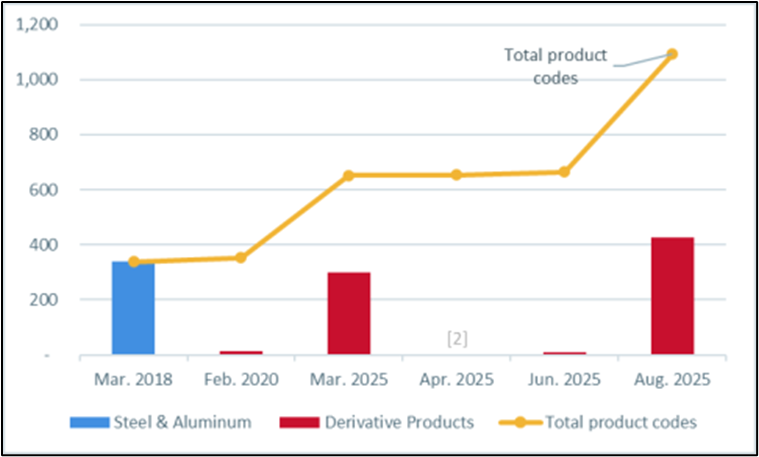
Source: Congressional Research Service, “Expanded Section 232 Tariffs on Steel and Aluminum” (Updated Sept. 26, 2025, https://www.congress.gov/crs-product/IN12519.
While tariffs collected under the steel and aluminum Section 232 actions were dwarfed by tariffs collected on automobiles and automobile parts in fiscal year 2025, the broadening of the steel and aluminum tariffs has resulted in the revenue generated from these tariffs increasing substantially compared to prior fiscal years. Specifically, between fiscal year 2020 and fiscal year 2024, the U.S. collected a total of $2.48 billion in revenue from the Section 232 tariffs on aluminum. In fiscal year 2025, that number increased to $2.96 billion, meaning that the U.S. collected more revenue from the aluminum Section 232 action in fiscal year 2025 than it did in the previous five fiscal years combined.
While the increase in revenue generated from the Section 232 tariffs on steel is not as substantial in percentage terms, the increase is still notable. From fiscal year 2020 to fiscal year 2024, the U.S. collected $8.14 billion in tariff revenue under the steel Section 232 action. In fiscal year 2025, the amount collected was $4.83 billion. This number is more than three times higher than fiscal years 2024 and 2023, when the U.S. collected $1.22 billion and $1.57 billion, respectively.
President Trump’s tariff policies have garnered intense scrutiny and judicial review. However, use of Section 232 has proven durable, with reviewing courts holding that the use of Section 232 to implement tariffs to be consistent with the law and the Constitution. Thus, Section 232 will likely remain an important tool to carry out the Administration’s economic and foreign policy agendas.